New glasses and Lasting software
Have you ever had the feeling, when you bought something so good, that you want to use it for the rest of your life and be buried with it? I just had it with my new pair of glasses.
I had been looking for new glasses for quite a while. My previous frame, which was actually my first frame, I had for 5 years, and it was in really rough shape. It was metal, probably something nickel-based, and its coating had started peeling off in many places, revealing the rough material underneath. It was bent and re-bent in many places, the screws were not holding because of that, and at some point I just glued the frame together with epoxy. Its design, with wire-like temples and rims, also promoted the bending.
As a person (or maybe even as a designer) I generally think quite a lot about the items I use. So I was picking my next frame quite carefully. I tried a lot of options in person, but also looked online. And when I stumbled across this Kamemannen frame, I guess I instantly thought: that's it.
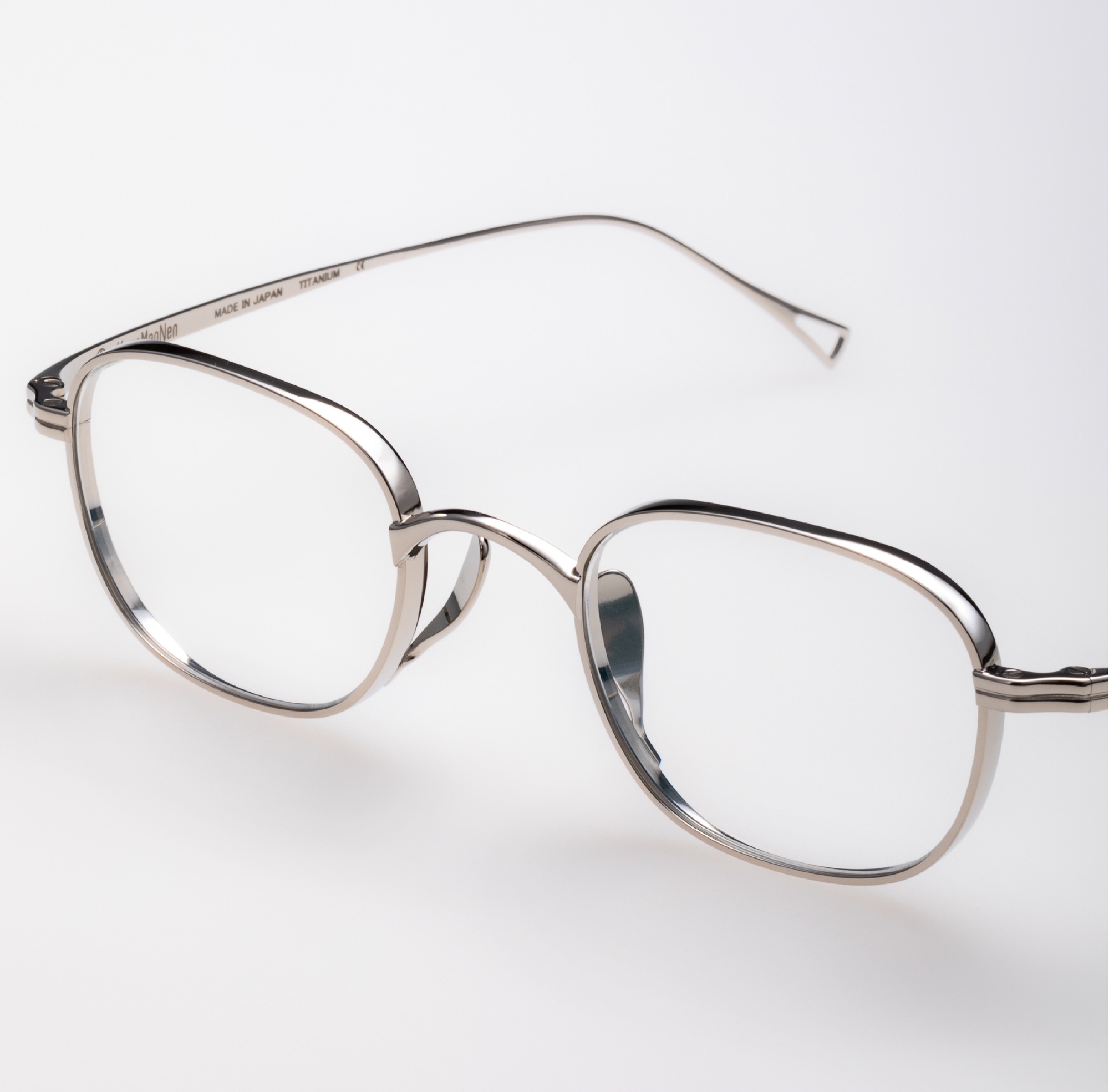
Here it is: a titanium frame from Kamemannen, model 114. There is not too much info in English about this frame.
The attention to detail in it is immaculate. It's a titanium frame, and not only that, it's quite smart about it, using two types of titanium: pure and beta. Pure titanium is used for the rim and the front of the frame, making it rigid and adding a bit of weight. Beta titanium is used for the temples, making them thin, spring-like, and resistant to bending. Titanium itself is also very corrosion-resistant (I had a problem with that on my previous pair). It has a quite unique nose pad design that makes the glasses sit deep and always in place, and the pads are titanium as well, so they never need replacement. Design-wise, it's a very elegant and minimalistic frame with some unique charm that you can't easily describe. The temples are thin and light and hold firmly on your head. The rim is thicker, to accommodate high-prescription lenses.
All of this together makes it feel timeless, durable, and high quality. And even if my taste grows and changes over time, I have a feeling I would still appreciate this frame. It might even be my last frame, and I would be happy with that.


But how rare it is nowadays to feel that something will outlast you. Most of the things we buy are designed to be replaced. When I'm getting a new piece of technology, let's say a phone, I know I will be changing it after a couple of years. It's the same with most technology. And not only technology. Clothing, for example, feels like it has an even shorter lifespan. Sometimes you are buying something and you already know that after some wearing and a couple of washes you will want to replace it. Or it will be out of trend even sooner.
I think almost everyone notices how each year everything becomes faster. Cycles and trends become shorter, new things come out more often, and overall life feels faster. It's related to age and perception, but also to the general acceleration of society and technology that is always present in current times. And so the things we produce as a society age poorly, and quicker. Most of them are, essentially, fast food.
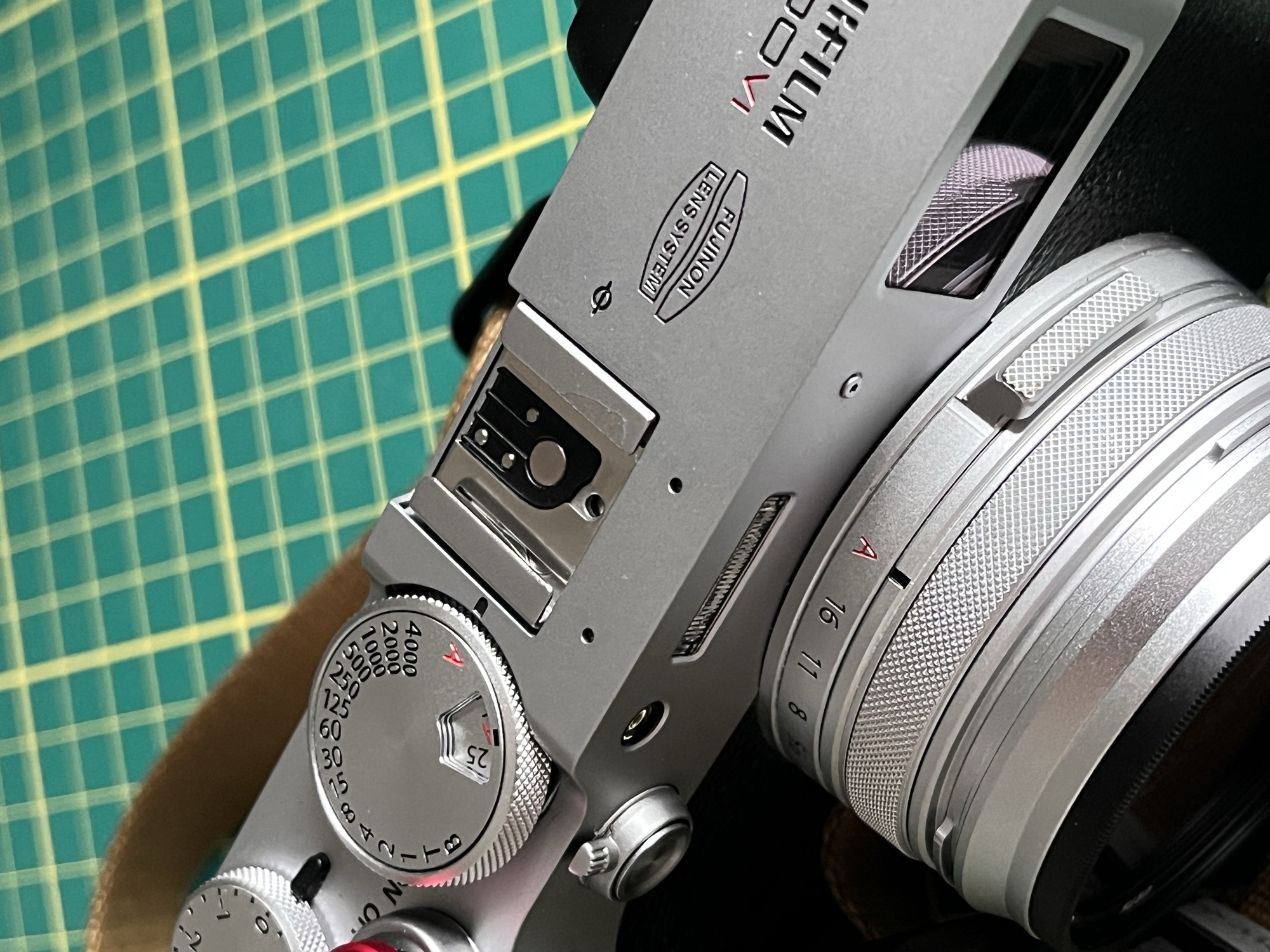
To show the difference, here is the opposite of the glasses. A camera, the Fujifilm X100VI. It's (technically) my first digital camera. Before that I shot some film and tried some of my friends' cameras. I love it quite a lot, and I really wanted it to feel timeless, to be my last camera. But for a couple of reasons, it doesn't feel like that to me. The main thing is that it doesn't feel great material-wise. It feels cheaper than it's priced, and cheaper than it could be. In the first month of light usage, the USB door broke. I took it to the service and they repaired it under warranty. Then the paint on the hotshoe started bubbling and peeling off. I have no idea why they painted it in the first place. The camera is silver, and the hotshoe is metal, just painted in a slightly different shade of metal. I never attached any hotshoe accessories, and I think I handled this camera rather carefully. The text on some often-used buttons has started to fade, you can feel wobble in a lot of the buttons and controls, and overall the materials feel cheap. Other things, like the position of the controls or just handling it in general, feel not natural. Or should I say, not refined enough? Like there is still quite a lot of room for improvement.
I enjoy shooting with it a lot anyway. But I do have a feeling that in a couple of years I will probably replace it with something better.
A lot of this is subjective, of course, and for other people it might be different. But it doesn't change the main fact: some things are made to last, and some things are made for a trend. And it depends on both the consumer and the producer.


With the progress in AI, you can feel this trajectory toward fast food things growing even faster. You can already see it in graphic design and software. Graphic campaigns, brandings, and logos used to be much more lasting. They were designed to be used for decades. Now it's a year, in a good case. Brands do rebranding so often that I don't even care that they are separate brands anymore. They look like one mass of visual sentiment flying around.
Same for software. We are producing more software than ever, yet I feel like we are maintaining less than ever. It's almost like the easier it is to produce something, the less thought people put into it.
Have you seen how many apps are made lately? Yet most of them are forgotten after the initial release. You can see it on Product Hunt. There are thousands of launches every month, but only about 10% of them get featured, compared to 60–98% between 2020 and 2023.
And established software is moving away from improving its best functions and fixing its existing problems, toward producing as many things as possible. I can't even count how many new features Figma has released since I started using it. I have no use for 90 percent of them. It's different from software that has a lot of functions that augment the main purpose. Like Adobe before: Illustrator has a ton of functions, and people are not using most of them often either, but they are made to add to the main workflow. So you find yourself experimenting over time, trying some new things from time to time, or discovering new ways of doing something. But the separate functions in Figma are the complete opposite of that.
A good example of lasting software is Obsidian, an app for notes, and probably one of the best examples of this. It's a file-based notes app, which means each note is a file, specifically an .md file, a widely used format that can be opened by many different apps. In a way, the .md file is the titanium of this app. Even if Obsidian itself disappears one day, the notes will outlast it. It's actively maintained. You can feel that it's refined, but also that it gets more refined with time. Each update fixes a problem or improves existing features, without breaking backward compatibility. It's extensible. Anyone can write a plugin or a theme for it and customize it in almost any way they want. It's mature, with quite a big ecosystem. New features are picked intentionally, not to jump on a hype train, but to augment existing workflows or make the app more future-proof. It's simple on the surface, but complex enough inside.
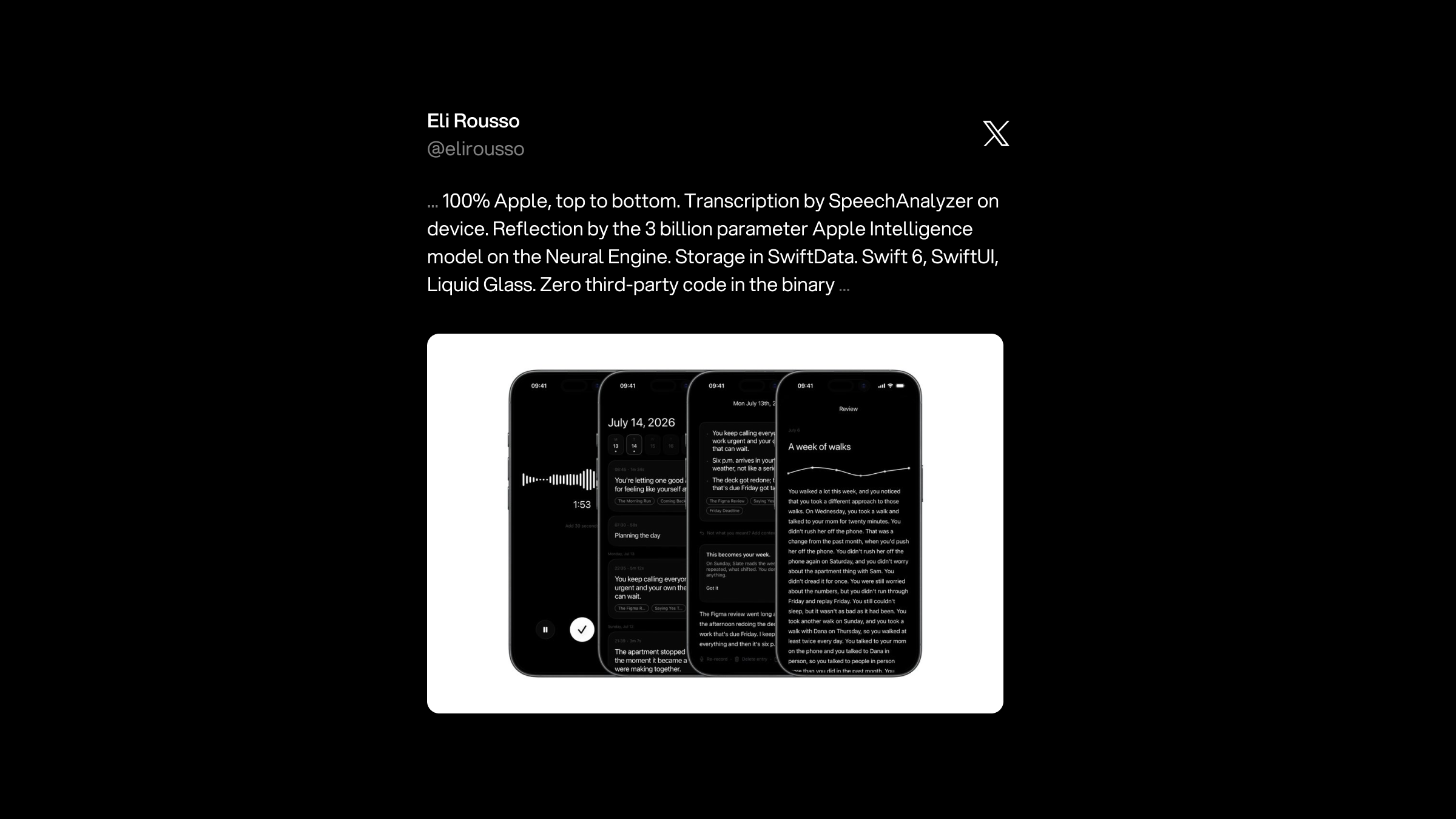
And Obsidian is just one of those things. There are quite a few similar creations, made with the intention to be used for decades. But compared to all the fast food things being produced, it's still too small an amount.

I think right now this matters more than ever. Our attention is already scattered across thousands of different things. Being able to just trust a thing, knowing that it will work well and will not fade away, is such a rare feeling. And on the practical side, it frees up part of your mental capacity. You are not thinking about new features, or about what to do when something breaks. I can't even completely describe it, but I have a feeling that trust in our society dampens together with how everything moves faster. You don't know if you can rely on someone, on a company, on a product. You invite someone for a coffee, and next time they just don't show up and you never hear from them again.
And more noise creates space for even more noise. When everything is already full of junk, it's appealing to not take the effort and to throw your piece of junk on the same pile.
But the proactive approach pays off much more than the passive one. In the end, it's all a choice. You decide what you use, and what you make. For me, maybe these are my last glasses. And I would be happy with that.